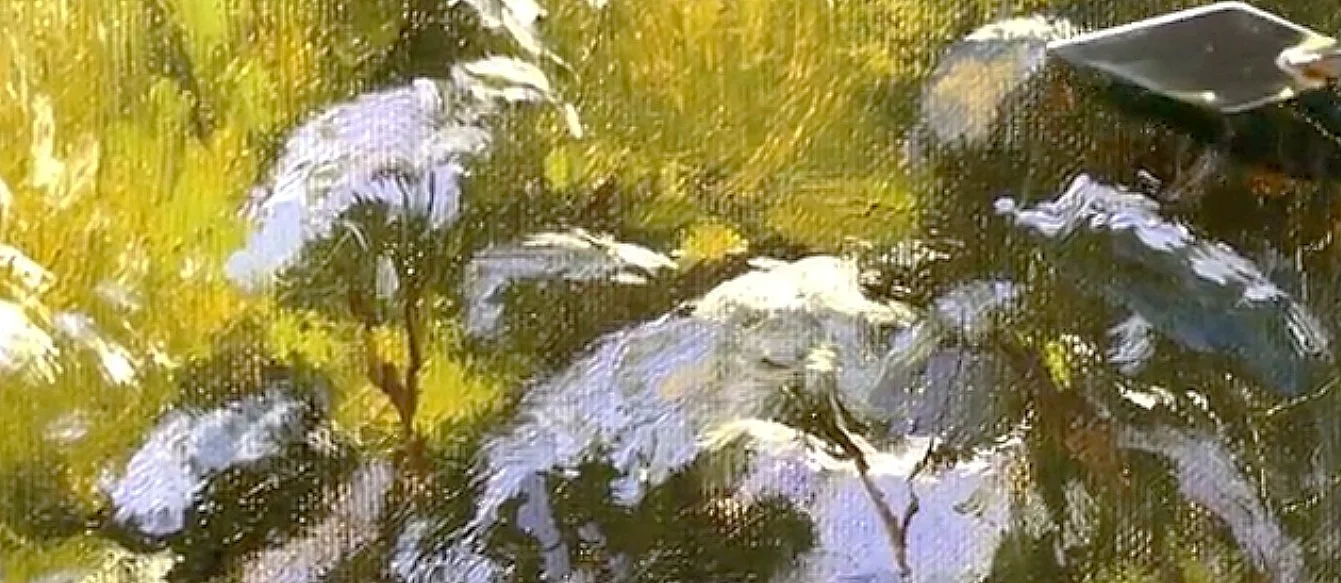
While the paint is still somewhat wet or tacky, I use a palette knife to scratch small branch shapes into the surface. The marks have a different character from lines painted with a small brush.
Work into the soft surface
In this close view of a snow painting, I show the areas where I scratch into the paint. The surface is not completely dry. That gives me an opportunity to make narrow, irregular marks directly in the existing passage, rather than adding another painted line on top.
Let the marks serve the painting
The branch marks are a small part of a much simpler overall statement. As I pull the camera back, you can see the snow, darker vegetation, and reflected light around them. I had worked to simplify a fairly complex subject, so the point is not to cover it with scratches. It is to find a few useful marks that describe what I need.
Compare the character of the tools
I mention that a very small brush could describe branches too, but it would give a different effect. The knife lets me make these particular marks quite quickly. Watch both the close view and the wider painting so you can judge their place in the whole. I also point out subtle reflected light in the snow, although I caution in the recording that the camera does not show the color exactly.
For a related lesson, see varying thick and thin paint.