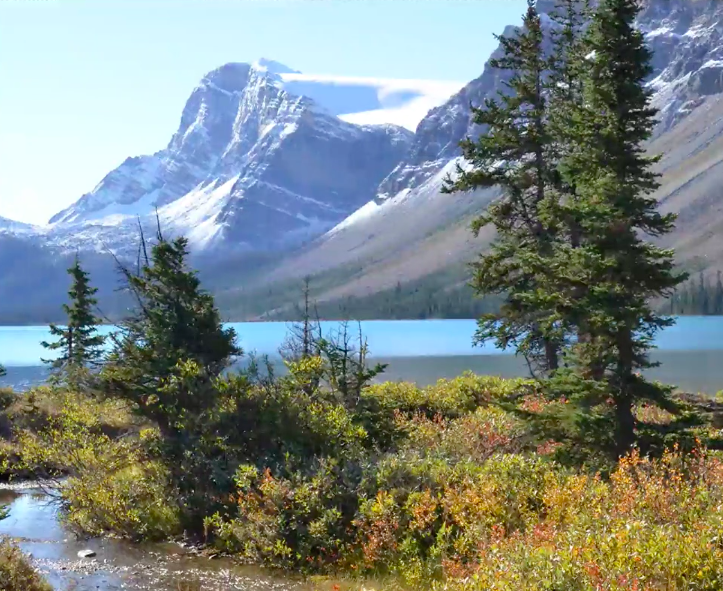
I get more useful photo references by moving around before settling on a design. In these Canadian Rockies photographs, a small change of viewpoint gives me different foregrounds, overlaps and ways into the same mountain scene.
Move before you commit
The first view had plenty to interest me, but I walked a little to the right and looked through the camera again. That brought a more useful foreground lead-in into the scene. The mountain was still there, while the relationship of the nearer shapes had changed.
I kept exploring and turned the camera vertically. Other views offered strong tree shapes and overlapping edges against the mountain. Those overlaps were part of what made each option worth considering.
Look for a design within the frame
Back at the computer, I also show a crop within one of the photographs. A reference can contain more than one possible arrangement; its original edges do not have to decide the final painting.
Before setting up outdoors, I suggest giving yourself a few minutes to look around the area you first liked. You may return to that original view, or find a stronger one nearby. The point is to investigate while the choices are still easy to make, rather than assume the first photograph contains the only design.
Continue with Looking at Design Options and How to Move Objects.