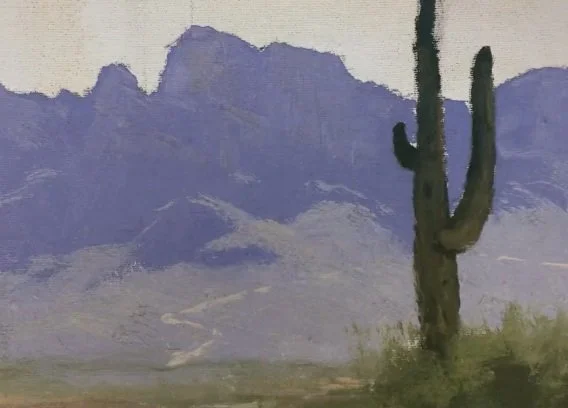
In the distant mountain shown here, I keep the light and shadow values close together so the mountain stays back. A much darker foreground saguaro gives me a reference for that relationship.
Begin with the whole mountain
The early block-in treats the mountain as one large shape. I am not looking for every crevice at that point. The small value differences come later, within that larger mass.
I also establish the dark saguaro in front. It could be another kind of tree in a different landscape; what matters here is the contrast between that foreground dark and the mountain behind it. I do not want the mountain to acquire the same dark strength.
Test the light-shadow interval
On the computer, I sample a lighter mountain passage and compare it directly with the shadow. The difference is smaller than you might expect. When I make the light too light, the mountain suddenly seems to jump forward.
I also compare a darker version of that passage, which loses some of the small amount of form I want. I am aiming for enough variation to describe the mountain while retaining its place in the distance. Squinting helps me see how closely these values belong together in this example.
Continue with The Importance of Values and How to Make the color GREEN recede.