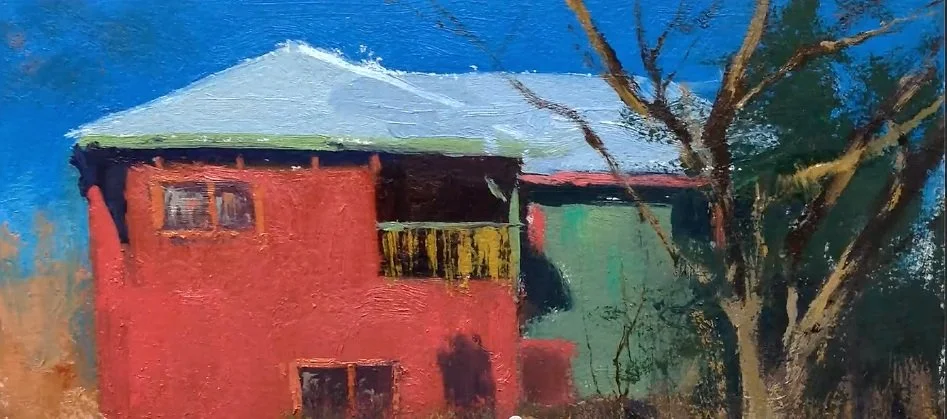
I can make a small painting clear without describing every piece of the subject. In this six-by-eight-inch example, I use the fence, tree, and balcony to show how suggestion and selective edges carry the picture.
Suggest the fence and balcony
The fence is made of separate pieces of wood, but I do not paint every one of them. The same is true of the balcony spindles. Those passages give enough information to be recognized while remaining part of the larger arrangement. Adding each small piece would not necessarily strengthen the painting.
Let edges disappear and return
The tree includes a firm edge that helps anchor it, along with softer passages where the boundary becomes less obvious. This is what I mean by lost and found edges: in one place the edge is clearly stated, and in another it disappears into the neighboring area. I want both kinds to play a part.
Look at the whole before adding more
When I pull back, the house, tree, and fence are easy to read. That is the test I want you to notice. A close view can make us feel we should explain more, while the full view shows how much the viewer already understands. Saying the same thing with fewer marks takes judgment and practice. I think of it as a form of shorthand, leaving enough room for the eye to complete the idea.
For a related lesson, see keeping detail to a minimum.