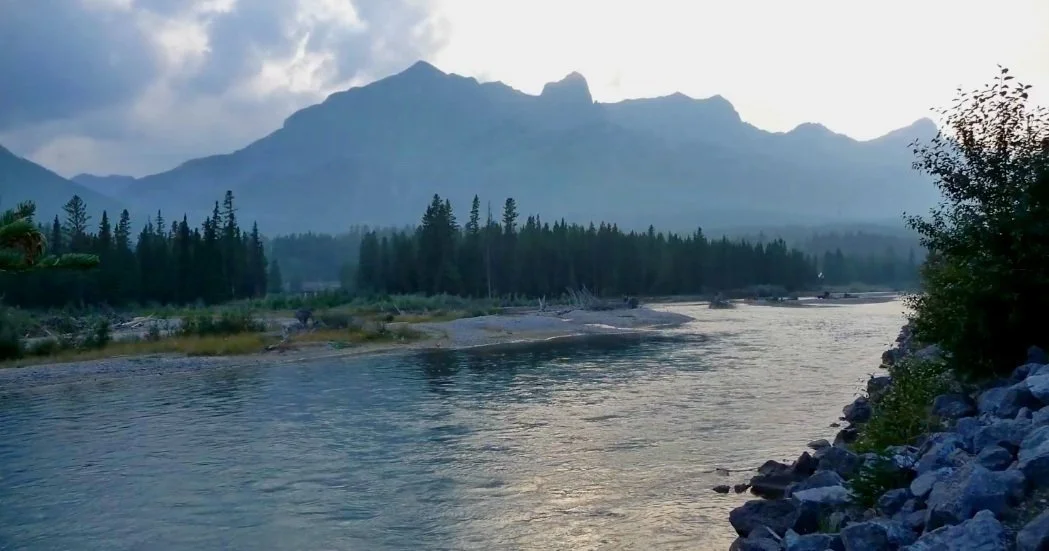
I can improve a reference’s design by shifting and resizing its elements. In this demonstration, I work digitally on a river photograph to see whether a different tree grouping and a few changes near the water will create a stronger rhythm.
Break up the level row of trees
The original trees sit along a fairly even line. I select a group, move it, and enlarge it so that its height changes the rhythm of the distant bank. By switching between the versions, I can judge whether that new shape gives the eye a more interesting path.
Consider the reflection and rocks together
Moving the trees also raises the question of their reflection. I sketch a corresponding reflection into the water and explore bringing some rocks farther into the river. These are quick tests of a possibility, rather than a carefully finished digital image. The changes help me think about the upper and lower shapes as parts of one design.
Ask what else the photograph could become
I return to the original and the altered version to compare them. A photograph can supply useful material without fixing every decision. Could something be larger, smaller, or shifted? Would a small interruption improve an otherwise even edge? I want to push those questions far enough to discover an arrangement that feels stronger to me, then use that judgment in the painting.
For a related lesson, see adjusting structural shapes.