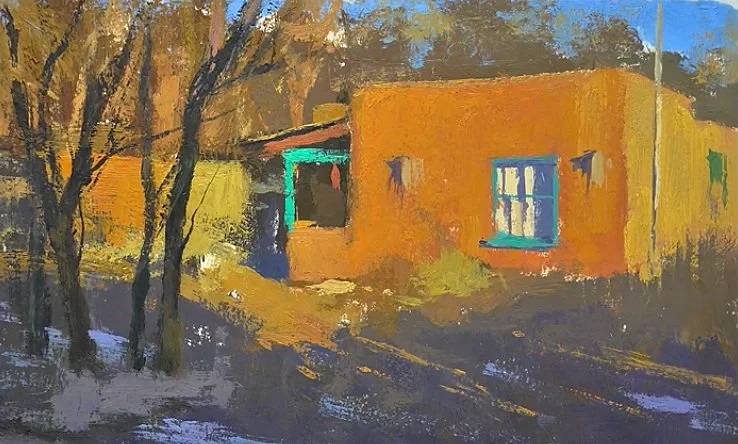
For me, painting more loosely begins with broad overlapping passages and a willingness to leave some things suggested. In this sequence, I show a house painting from its simple drawing through the final touches.
Let the block-in stay open
I begin with a simple line drawing and loose patches of paint. At this stage I am testing value and color, without trying to make every edge exact. Some passages are broken and irregular. That gives me room to develop the whole arrangement before concentrating on small descriptions.
Paint through the future tree
One useful example is the ochre-colored area behind the tree. I paint that passage through the place where the tree will eventually stand, then paint the tree over it. I do not carefully stop each background mark at the tree’s outline. That overlap helps avoid a cutout appearance.
Choose where to become more specific
Near the end, I tighten the window and a few other areas, while leaving much of the ground and surrounding paint more freely stated. When I zoom in, you can see separate strokes and overlapping colors; when I pull back, the subject becomes clear. The viewer can recognize snow, a house, and a tree without a full explanation of every part. Watch how the clearer accents sit within that looser setting rather than replacing it everywhere.
For a related lesson, see painting through objects.