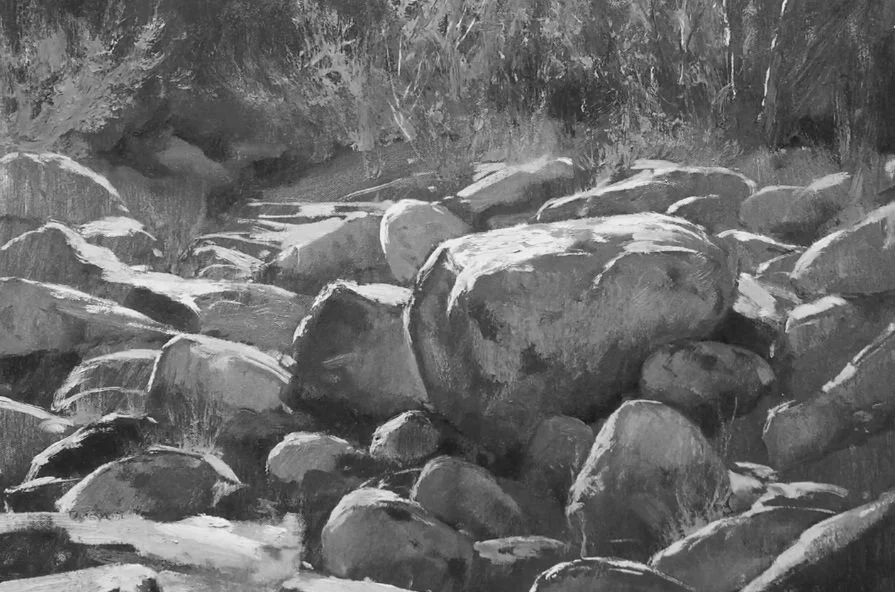
I paint through a shape by laying in a broader passage first, then placing other values over it. In this continuation of the painting-through-objects lesson, I use a rock painting and digital tools to reconstruct what that means.
Begin with the whole rock shape
The original painting was 18 by 24 inches, so the individual rock I discuss was not very large. I demonstrate the likely block-in as one darker shape, temporarily covering the light passages on screen. That lets you see the broad beginning underneath the more developed painting.
Bring the light across the darker start
I then add lighter values over that beginning, leaving some of the underlying darker paint visible. There is a progression from the darker block-in to a lighter passage and another lighter note. The digital marks explain the sequence; an actual brush gives the paint its own character.
Compare overlapping with stopping at every edge
For contrast, I show two adjacent values painted right up against each other. That approach can make the meeting feel more mechanical. Overlapping the passages gives me a more organic result here. I also acknowledge that sometimes I need to stop at an edge. The useful habit is to look for opportunities to paint through first and lay another passage over it, rather than automatically treating every boundary as a place to stop.
For a related lesson, see painting loosely through a subject.