I simplify because a painting can lose some of its power when I explain every part of it. Here I compare two snow paintings and talk about the suggestion and mystery that can disappear as I keep working.
Notice a promising stage
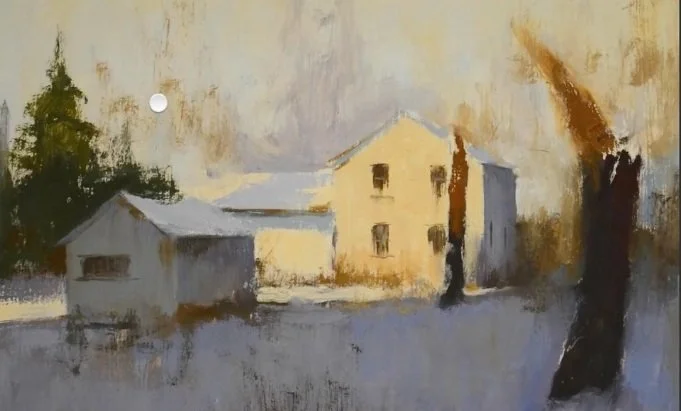
The first image shows a smaller painting at a stage I liked, even though the tree and other parts were not fully developed. I continued working on it, but looking back, that earlier stage taught me something. The incomplete passages left room for the viewer, and I did not need to spell everything out to communicate the feeling.
Compare suggestion with description
The second painting is more polished and more explicitly described. I put the two images side by side so you can compare them. This is a personal judgment about what I value in these paintings. More detail is an option, but in the first example I feel that the unresolved areas contribute to its strength.
Pause before another round of work
Leaving things out can be difficult. Once a painting is underway, it is easy to keep adding because I can see more to describe. My practical suggestion is to stop, put it away, and return later—perhaps after a week. That distance can help me see more clearly whether another passage of painting would strengthen the work or remove something I already like.
For a related lesson, see simplifying a complex painting.