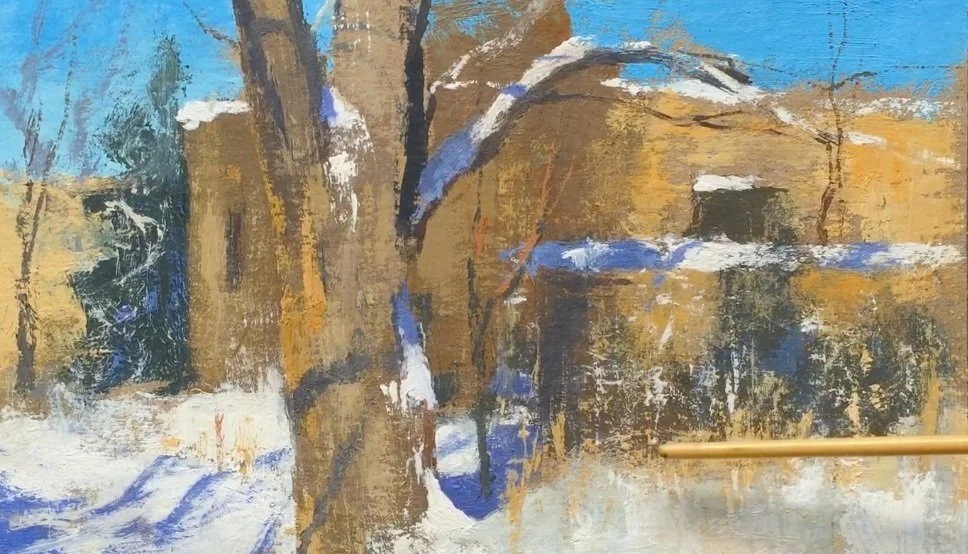
I use soft transitional areas to let one shape lead gently into another. In this snow painting, I vary those transitions so the wall, tree and snow feel connected without making every boundary equally hard.
Look at the meeting of two shapes
The wall and snow could meet in one hard line. Instead, I point out areas where grass and broken marks help the eye move from the snow into the wall. There is enough information to suggest the meeting without outlining every part of it.
The tree gives me another opportunity. Where it reaches the snow, I want an organic connection, not the feeling of a separate object ending abruptly against a white shape.
Keep some edges firm
This does not mean softening every edge. In the demonstration I also point to a firmer division between light and shadow. That harder area gives me something to compare with the gentler transitions.
I want to make these choices consciously. Our eyes can fill in quite a bit, so I do not have to spell out every boundary. Before finishing a passage, I ask how I want the eye to travel into the next shape and whether that transition needs to be softened or strengthened.
Continue with How To Unify Shapes and Paint Through Objects part 1.